

As an owner-operator, you are definitely a key pillar of the freight system in the USA. You handle everything, transporting goods, sticking to very short schedules, overseeing logistics and paperwork, and making sure your truck runs great. It’s tough work and you need to be absolutely focused since there are many different tasks to handle at the same time.
But one thing you cannot afford to bypass is DOT inspection preparation. Obligatory inspections check not only the mechanical condition of your truck but also the extent of your compliance with FMCSA regulations. Passing such inspections doesn’t only mean avoiding fines; it also means securing your profits and driving power.
By mastering DOT inspection preparation you will be safeguarding the essentials:
Safety: Worn out parts and other maintenance issues that might lead to accidents are constantly monitored by maintenance thereby ensuring everybody’s safety on the road.
Your CSA score: Clean inspections contribute to the strong Compliance Safety Accountability score.
Insurance costs: Financially wise scores signify less expensive policies.
Business continuity: Avoiding being out of service allows you to keep on transporting goods and collecting income.
This guide will take you through everything that you need to know in order to pass the inspection coming up.
Understanding DOT Inspections for Owner-Operators
DOT inspections are requisite safety evaluations that consist of your truck as well as your driving compliance. The inspections may be performed on your vehicle at weigh stations, rest areas, roadside pullovers, or even at the place of your business. Knowing the various inspection levels makes it easier to plan for the inspectors’ scrutiny of your vehicle.
The Six DOT Inspection Levels:
- Level 1 (Full Inspection) – The most comprehensive check covering both vehicle and driver, including a 37-step vehicle inspection and thorough document review
- Level 2 (Walk-Around) – Focuses on driver credentials and vehicle exterior without crawling under the truck
- Level 3 (Driver-Only) – Reviews your CDL, medical card, HOS logs, and other driver documents
- Level 4 (Special Inspection) – Targets one specific item, often used during CVSA Roadcheck campaigns
- Level 5 (Vehicle-Only) – Inspects the truck without the driver present
- Level 6 (Enhanced NRC) – Examines radioactive material shipments specifically
Evaluations are performed by certified state troopers, Department of Transportation officers, and CVSA-certified inspectors. Every year, commercial vehicles that weigh more than 10,000 pounds must pass an inspection, but roadside checks may take place at any time during the year.
There are various ways to select vehicles for inspection, but certain factors will raise your chances: for instance, mechanical issues that are noticeable, registration plates that are not current, doubtful driving, or a low CSA rating connected with your DOT number. Past citations result in higher inspections during Compliance Reviews, and keeping your records clean is a key part of a smooth business.
DOT Inspections: Essential Truck and Driver Documents
Having your documents ready when the inspector comes to your truck can be the deciding factor on whether it is a quick or long inspection process. Some important documents need to be produced immediately when requested.
Driver Documents Required:
Valid CDL: The class of the license should match the class of the vehicle being driven, and should have the proper endorsement on it for the type of cargo carried.
Medical Examiner’s Certificate – This is often referred to as your “medical card.” It is a document showing that you are physically qualified to drive a commercial vehicle. It needs to be current.
Hours-of-Service Logs – You will have to present records of your duty status for at least the past seven days, which can be maintained through your Electronic Logging Device or paper logs if you qualify for an exemption.
Keep these papers in a special folder or binder very close to the driver’s seat. Inspectors like it when you can immediately show them all that they need without searching through messy paperwork. If you are operating an ELD, in that case, you should know how to maneuver the system and present your logs when required. Short-haul drivers who are taking the ELD exemption must carry documents that confirm their exempt status, together with paper log backups. Your vehicle registration, insurance proof, and any permits should also be accessible during the inspection.
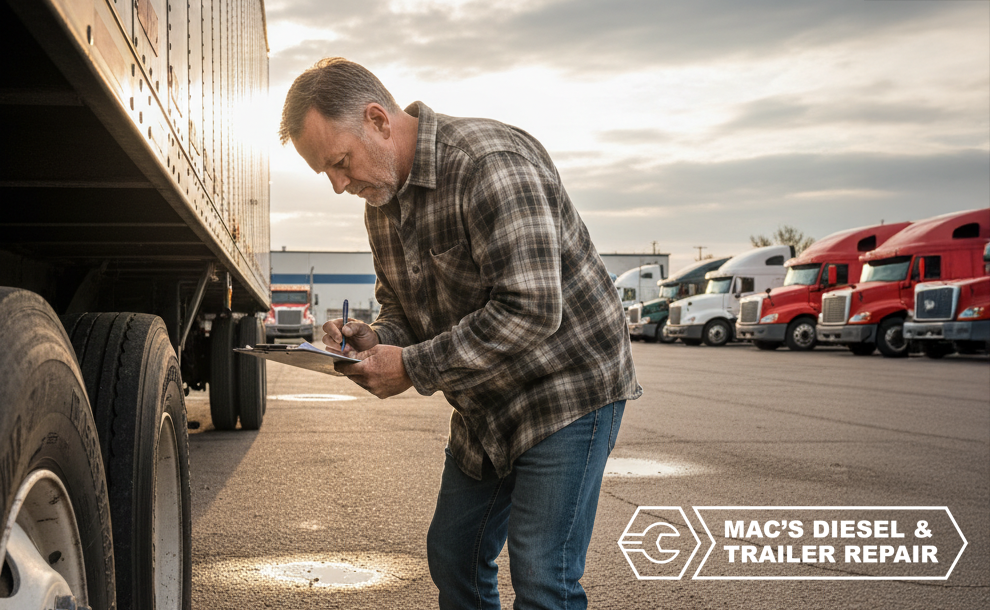
DOT Truck Inspection Requirements in Full
The mechanical systems of your truck are put under very strict control during DOT inspections. Inspectors evaluate systematically all the critical components that have a direct impact on road safety and your legal ability to operate.
Brake Systems receive the most attention during inspections. Inspectors check for:
- Worn brake pads that fall below minimum thickness standards
- Air leaks in the brake lines or connections
- Cracked or damaged hoses
- Proper adjustment of slack adjusters
- Adequate air pressure buildup and holding capacity
Tires must meet strict standards across your entire rig. The minimum depth of the steer tires shall be 2/32 inches, while the minimum for drive and trailer tires shall be 4/32 inches. Inspectors check the tires for proper inflation, mismatched sizes, bulges, worn-out cords, and any other damage likely to cause a loss of structural integrity.
Lighting and Reflectors are the means that make sure you are seen on the road. A full set of lighting that includes a headlight, brake light, turn signal, and clearance light must work properly. If there are any reflectors that are missing or broken, that would be a violation right away.
Inspectors very carefully check your truck for any leaks that can be seen- be it fuel, oil, coolant or brake fluid. Even a small drip can be the cause of a violation, as it shows that the system might be failing and posing a danger.
Safety Equipment and Cargo Securement Standards
In addition to the mechanical components, the inspectors look very carefully at the emergency equipment & safety items to see that you are ready for roadside emergencies. The following is a list of what they check for:
- A working fire extinguisher specifically rated for truck use, mounted within easy reach (not buried under cargo or loose equipment)
- Three reflective triangles in good condition to alert other drivers when you’re stopped on the roadside
- A current Hazmat Response Guidebook accessible in your cab if you’re hauling hazardous materials
- Fully functional seatbelts without fraying or damage
- All safety gear remaining accessible during transport (no items blocking your emergency equipment)
Cargo securement violations are common on inspection reports. To avoid them, make sure your load stays stable throughout transit using appropriate tie-downs, straps, chains, or binders. Inspectors will be checking for:
- Loose or frayed straps that could snap during transport
- Insufficient number of tie-down points for the cargo weight
- Shifting loads indicating improper distribution
- Damaged or missing securement hardware
It’s your responsibility to prove that your cargo won’t shift, tip, or fall during normal driving conditions, including sudden stops and turns.
Common DOT Inspection Violations to Avoid
Knowing the most frequent DOT violations helps you focus your pre-trip inspections on the most important areas. According to FMCSA statistics, some mechanical and documentation problems consistently crop up during roadside inspection.
Brake system failures lead the list of violations. Inspectors often cite worn-out brake pads, slack adjusters that are out of adjustment, and air leaks in the braking system. These aren’t just inspection failures-they put you and everyone else on the highway at grave risk.
Not too far behind are tire violations. Citations include those for tread depth less than 2/32″ on steer tires, mismatched tire size on the same axle, and visible damage such as bulges and exposed cords. Proper inflation is just as important as tread condition.
Lighting/ Reflector problems rank among the easiest violations to prevent, yet amazingly manage to still crop up time after time. Broken headlights, non-working brake lights, missing turn signals, and damaged clearance lights will always result in citations. Cargo securement problems can be represented by loose or frayed tie-downs, not enough straps for the load weight, and signs of shifting of cargo during transit.
Practical Tips to Prepare and Pass Your DOT Inspection Smoothly
The first step in knowing how to pass a DOT inspection is creating and maintaining inspection-ready habits that become part of your daily routine. Often, it is just a matter of being well-prepared that makes the difference between an easy, smooth inspection and a frustrating delay.
1. Create and use a thorough pre-trip checklist. Prepare a detailed pre-trip checklist for every system of your truck and follow it. Before every trip, inspect the brake parts, tire conditions, lighting systems, fluid levels, and safety equipment. This basic practice detects issues before an inspector does.
2. Always keep all the required documents in one folder or binder that stays with you in the cab. Your CDL, medical card, current HOS logs, vehicle registration, and proof of periodic inspection should always be accessible. Forcing the issue of paperwork takes time and creates a bad impression at inspections.
3. Know your ELD system inside and out Know your ELD system inside and out. Inspectors could ask you to demonstrate how you log duty status changes, review previous days, or deal with any malfunction. Being able to navigate your device with assurance shows professionalism and compliance. Have backup paper logs on hand in case of technical issues.
4. Review your inspection history regularly. Keep regularly checking your inspection history for patterns. If there have been violations in the past, provide proof of what you have done to rectify the situation. When you can show the inspectors that you have handled the old issues, it is a clear sign of your commitment to safety and compliance.
5. Keep track of FMCSA rules. Always be aware of the changes in FMCSA’s rules and regulations. Owner-operators might be taken by surprise by sudden changes in requirements for ELDs, inspection standards, or even cargo securement. Regularly look for industry updates or join owner-operator forums where regulatory changes are discussed.
Consequences of failing a DOT inspection and how to respond
The results of a failed DOT inspection will run the gamut from minor inconveniences to severe disruptions in business that dig straight into your bottom line. When an inspector uncovers violations during your roadside check, you will receive one of several outcomes depending on the severity of the issues uncovered.
Consequences of a failed DOT inspection
Warnings or citations: The minor infractions are normally warnings or citations that need correction, but let you continue operating. You will have 15 days to submit proof that you have made the correction. OOS order: More serious violations lead to an Out of Service order, a situation where you are not allowed to move your truck until such time as the issue has been fixed. Immediately, this will begin to impact your delivery schedules, causing you to miss deadlines and lose income with your truck sitting idle.
The Ripple Effects of Violations
The ripple effects extend far beyond the immediate inspection. Each violation feeds into your CSA score, a public record that follows your DOT number. A poor CSA score creates a cascade of problems:
Higher insurance premiums as carriers view you as a greater risk
Reduced load availability since brokers and shippers check CSA scores before offering contracts
Increased likelihood of future inspections as you become flagged in the system
Potential DOT audits if your score crosses critical thresholds
The Financial Impact
A single failed inspection can set you back thousands in repairs, fines, lost revenue, and inflated operating costs. Prompt actions to rectify violations accompanied by thorough documentation of all repairs done not only help to keep your CSA score damage low but also facilitate the progress of your business.
Making Use of Professional Services for Maintenance and Repairs
Keeping your truck ready for DOT inspections does not necessarily mean performing all the repairs yourself. Do not let a failed inspection waste your precious time, money, and energy; instead, join a group of skilled diesel repair technicians. A reliable service center for semi-truck repair knows the exact requirements of the inspectors and will solve the potential problems before they become expensive issues.
Advantages of Preventive Maintenance Services
Any preventative maintenance service provider like us here at Mac’s Diesel and Trailer Repair will be able to customize their services to the needs of owner-operators. Their mobile diesel mechanics are experienced enough and equipped with the necessary tools to take care of the job with the least amount of downtime while you are on tight schedules. These technicians specialize in heavy-duty truck repair conforming to DOT standards, ensuring that every part is tested and passed.
Advantages of Regular Partnerships with Qualified Mechanics
Regular partnerships with qualified mechanics provide several advantages:
Scheduled maintenance that catches issues before roadside inspections do
Documentation of all repairs and services for inspection records
Expert knowledge of current FMCSA regulations and compliance standards
Quick turnaround on repairs to keep you hauling freight without extended delays
Professional service centers maintain thorough service histories that show your dedication to compliance, which can be very beneficial come inspection time or when it’s time to address your CSA score.
Choose Mac’s Diesel and Trailer Repair
Mastering your DOT inspection preparation isn’t simply a matter of compliance; it is protecting your living, keeping your CSA score, and ensuring that your business operates without a hitch. Having more inspection-ready trucks means you are closer to having fewer delays, lower insurance premiums, and more time on the road making money. Do you want to ensure that your truck gets through every inspection? Give us a all at Mac’s Diesel and Trailer Repair today at (859) 433-4062 for professional support with a full scope of truck maintenance services.
Our mobile diesel mechanics provide heavy-duty truck repair and preventive maintenance to DOT standards, so you are ready for any situation that might arise on an inspection. From pre-trip inspections to brake service or a full-vehicle check, we’ve got owner-operators like yourself covered with dependable, professional service that keeps you compliant and confident on the road.