

Among all heavy-duty vehicle operations, there are very few considered to be more difficult and requiring greater skill than backing up a semi-truck trailer into a confined area. To the professionals in the diesel and trailer repair industry, knowing the particulars of this maneuver is essential. No matter if you happen to be an experienced trucker or just a person wanting to watch, this blog post is going to take you through all the difficulties that come with the backing a semi-truck trailer.
The first thing we have to do is to deal with the most basic problem the non-intuitive steering mechanics of the counter movement. In the case of a car driven in reverse, the front wheels steer into the direction in which you want to go. Easy, isn’t it? That is not the case with a semi-truck. The so-called fifth wheel is the point at which the cab and the trailer are connected. This means the steering wheel being turned to the left results in the trailer moving to the right and vice versa.
This non-intuitive driver movement takes a long time to be perfected and can be extremely irritating for newcomers. The trailer could be swayed greatly by merely a slight steering motion causing it to either jackknife or completely miss the target. So, what does it imply for you? If you are a truck driver, it stresses the importance of patience and practice. For the repair workers, it brings out the necessity of being very careful in the maintenance of such system making them precise.
Next is the truck length issue. A typical semi-trailer truck with a 53-foot trailer can easily exceed 70 feet in total length. Just imagine the length of five cars lined up one behind another. How difficult it would be to control that giant vehicle from the opposite side where visibility is poor? The longer the trailer, the slower it gets when backing up.
Shorter trailers, such as 20-foot ones meant for city deliveries, have instantaneous reactions, which may sound like an advantage but it is actually a problem as even the smallest steering input can cause them to get out of line. Therefore, long trailers are slow to react but more predictable.
Short trailers react fast but can swing out of control in seconds. This is why many truckers say short trailers teach you humility. We, at Mac’s Diesel and Trailer Repair, consider this knowledge as priceless. It assists us in recognizing the specific difficulties our customers face and consequently, it allows us to adjust our services accordingly.
Visibility is one of the most significant problems when it comes to backing a semi-truck trailer. Since truck cabs lack rear windows, the side mirrors or on certain occasions, a rearview camera are the sources the drivers depend on entirely. However, the mirrors only provide two flat viewpoints and there are large blind spots on either side of the trailer. The back corners of the trailer and the area directly behind are not visible. During night hours or rainy conditions, even the mirrors are practically useless.
This is the reason why every move is made very slowly with continuous adjustments. The driver checks the left side, then the right, keeping an eye on the trailer’s position and predicting where it will be in a matter of seconds. It is not a matter of response; it is a matter of foreseeing. This translates into providing our customers’ trucks with the best possible visibility aids, starting from high-quality mirrors to sophisticated camera systems. Nevertheless, not all trailers are easy to handle in the same way.
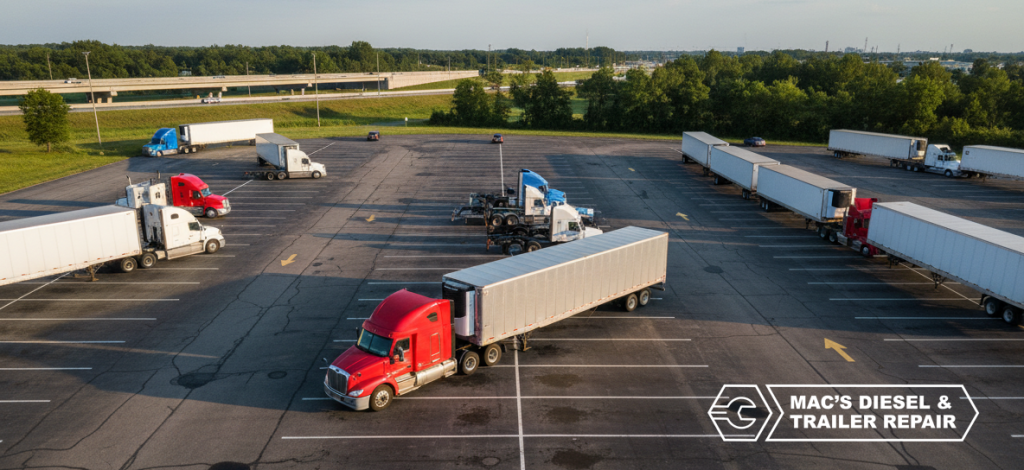
Let’s break down how a few of the most common types act differently when backing or parking.
Standard Drive Van Trailers
These are the well-known general freight trailers with a size of 48 or 53 feet. They have a large weight, their stability is high, and their operating conditions are fairly predictable. The length provides smoother movements, but at the same time, it demands a lot more space for the maneuvers. One cannot make quick, sharp corrections without running the risk of jackknifing the rig.
Refrigerated Reefer Trailers
The weight is increased due to the refrigeration unit and insulation of the trailers. They are now a little less responsive, and the weight increase may also cause difficulties in getting traction on icy or rough ground. The driver has to make sure he doesn’t miss the front refrigeration unit while docking, so the necessity of utmost precision during tight docking operations is greater.
Tanker Trailers
Fuel and liquid tanker trucks are probably the most difficult to park since the liquid moves. Liquid behaves like a solid in that once you stop, it continues to move forward or backward inside the tank, creating pressure on the walls of the trailer. This shifting weight can cause instability in the trailer, especially when reversing or stopping suddenly. This is why tanker drivers have to move slowly and smoothly. Every turn or brake input causes waves inside the tank.
Flatbed Trailers
In some respects, these are less complex due to the fact that they have better visibility around them, but their main application is in construction areas or tight loading zones where there is nothing but very limited spaces for turning. The cargo being oversized or unbalanced can influence the trailer’s behavior.
Multi-Trail Setups
Trucks with double and triple trailers are indeed a different story. Each trailer adds another pivot point, another joint that reacts separately. Reversing a single trailer takes skill. Reversing two trailers is almost impossible. In most cases, doubles and triples are never reversed. Drivers simply disconnect and reposition them individually.
The movement of a truck in reverse is not a direct one. It consists of a succession of arcs. The rear wheels of the trailer provide a point around which the whole operation revolves. The right steering of the cab is not the issue; rather, it is the positioning of the trailer that is the tricky part, which often implies that the truck must be turned in what resembles the wrong direction. Inexperienced drivers tend to oversteer, hence making sharp angles that are impossible to recover from.
In contrast to them, experienced drivers have grasped the repetition of the process. Little, gentle inputs, constantly monitoring the trailer’s reaction. And as soon as the trailer begins to straighten, they counter steer to stay with it perfectly into position. It’s like doing a tango with 40 tons of steel. If you make one wrong move, you’ll lose the balance.
With all that in mind, picture yourself in such a situation during a pouring rain, on a frozen surface, and at night with cars and forklifts all around you. Truck stops, distribution centers, and loading docks are seldom designed for heavy trucks. Drivers frequently have to do it in such a way that they can see almost nothing. Even experienced truckers dislike such blindside parking. It is the area where most low-speed accidents occur. That is why it takes sometimes even up to 15 minutes to get the position right. While it may look slow from the outside, every movement is intentional in that cab.
Thankfully, modern trucks are becoming more intelligent. The use of advanced technologies like 360° camera views, automatic trailer angle sensors, and steering assist technology is making it safer for drivers to line up. Some European trucks offer even the possibility to control reversing via remote, allowing drivers to be outside with a joystick or tablet for better visibility. However, the technology cannot take the place of experience, as every trailer, every dock, and every slope has its own slight difference.
What makes the parking of semi-truck trailers difficult?
The reasons can be long, heavy, blind-spot vehicles, and they turn the opposite way from your thoughts. Add weather, different trailer designs, and unpredictable environments, and you get one of the most difficult maneuvers in transport. It is not just skill; it is an art form. A good driver appears to be doing it easily. A great one is able to slide a 70-foot rig perfectly between two trailers in the dark at the first try. The next time you catch a glimpse of a truck driver reversing into a tiny spot, do give them a respectful nod. What looks like a slow parking act is really a control, patience, and geometry on wheels masterclass.
Choose Mac’s Diesel and Trailer Repair
We understand at Mac’s Diesel and Trailer Repair that there are some very unique problems associated with steering heavy-duty trucks. Our highly trained technicians are dedicated to providing great service so that you have no issues with your vehicles. We are the go-to people, whether it is regular maintenance or very complex repairs. Therefore, if you are in Lexington, KY, and in need of reliable diesel and trailer repair services, feel free to reach out to us at (859) 433-4062. Let Mac’s Diesel and Trailer Repair be the best friend who keeps your fleet running and your business thriving.