
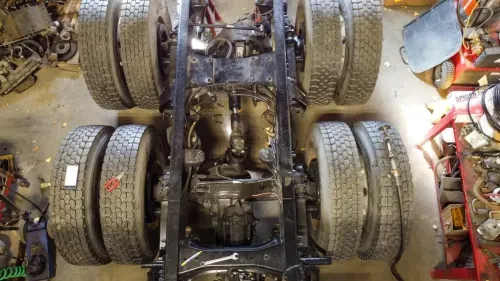
Have you ever wondered why trucks have more wheels than cars? Well, this is related to weight and safety. While four is the normal number of wheels for cars, semi-trucks will normally contain multiple axles to support heavier weights. This configuration of the wheels is significant for maintaining the stability of the truck, contributing to safe driving, especially when carrying heavy goods for long distances.
Knowing semi-truck design isn’t reserved only for truck enthusiasts but is a vital part of trucking for anyone interested in road safety and the industry of logistics. Our professionals here at Mac’s Diesel Repair know the ins and outs of Semi Truck wheels, and can repair your truck up right when something looks amiss, simply stop by today!
Why Do Semi Trucks Have More Wheels Than Cars?
The first thing one might notice with a semi-truck on the highway is that it has a lot of wheels. Unlike common cars, which normally have four wheels, semi-trucks have many axles. This difference is not for show but rather as an important part of truck design to enhance stability and guarantee road safety.
Why Semi Trucks Use Multiple Axles
The main reason semi trucks have so many axles is to support the heavy loads in which they carry. A car only needs two axles since it does not transport a high volume of cargo. That being said, semi trucks can carry as much as 60 tons or more! This load, when distributed among several axles, does not overload any one axle, which could cause dangerous situations such as axle failure or damage to the road.
Advantages of Having More Wheels
Increased Stability
With more wheels touching the pavement, semi trucks have greater traction and stability. This is particularly critical when making a turn or going uphill because it reduces the risk of tumbling over or jackknifing, either of which is very hazardous to the truck driver and other drivers sharing the road.
Better Braking Performance
More wheels mean more brakes that a truck can have installed. This setup allows for better braking efficiency, shorter stopping distances, and improved control during sudden stops.
Optimized Payload Capacity
Towing greater weights in a balanced manner over a number of axles keeps trucks within legal limits without sacrificing safety. This increases not only the carrying capacity of the vehicle but also reduces strain on individual tires and road surfaces.
Multiple axles for semi trucks are not just to carry heavy cargo but are actually designed to balance load management with efficiency and safety. Understanding this setup shows the important role these vehicles play in keeping transportation systems safe and effective.
The Role of Weight Distribution and Legal Load Limits in Truck Design
In understanding semi-truck design, one must consider the part played by weight distribution. Multiple axles are, of course, the featured components, which help distribute the weight of any cargo evenly across the vehicle. This even distribution is necessary to minimize ground pressure, preventing damage to the road surfaces. The fewer axles a truck bears its loads on, the more it raises the potential for road and infrastructure damage-such as bridge damage.
Operating Key Factors in Axle Load Management:
Even Weight Distribution
With several axles, the weight of the truck and cargo will be distributed over a big area. This reduces the impact on one point and keeps the integrity of the road intact.
Ground Pressure Minimization
The lower the ground pressure, the less stress on roads, and that, again, is very important to avoid structural damage while crossing bridges.
Legal regulations concerning axle load limits play a significant role in shaping truck design. In different regions, specific rules govern how much weight each axle or group of axles can support. These are quite important to ensure that trucks operate safely and do not compromise road infrastructure.
Impact of Regulations
Adhering to legal axle weight limits allows trucking companies to optimize their operations. Companies can maximize the amount of transport without exceeding legal limits, improving efficiency and increasing profitability.
Each region may have different legal requirements. Understanding these regulations helps trucking companies avoid penalties and operate within safe parameters. This strategic use of multiple axles in big rig trucks is how heavy loads are balanced while regional laws are adhered to, protecting both the vehicle and public infrastructure.
Other Advantages of Having More Wheels on a Truck
Having a number of wheels on a semi-truck is not only important in terms of weight distribution but also in terms of stability and handling performance, particularly on sharp turns and inclines.
Stability and Handling Performance
Stability through Turns
The added axles provide semi-trucks with greater contact points on the road, meaning more stability while making turns and curves. This reduces dangerous situations that may result from undue leaning of the truck.
Traveling on Grades
Extra axles provide balance during travel on grades and distribute the load uniformly so that no single part has to bear undue pressure that might affect the handling.
Prevention of Rollover
By allowing more wheels on a vehicle, the possibility of rollovers and jackknifing is reduced. More axles mean better traction and control, which is something very important for safety when making sudden maneuvers or braking.
One might question, “Why does a truck have so many wheels and a car does not?” Its purpose is not only confined to weight management but also extended to enhancing the overall safety and effectiveness of these juggernauts on our roads.
Tire Longevity and Mobile Diesel Repair Services
With semi trucks, multiple axles are essential for a number of reasons, such as increased tire life. Because weight is distributed across these various axles, the load is not concentrated on just a few tires. This balance reduces excessive heat buildup and wear and tear on individual tires, helping them last longer and perform better.
Effective tire care would mean operational efficiency. Besides cost savings, a well-maintained set of tires reduces downtime, keeping trucking companies on schedule without unexpected delays.
Choose Mac’s Diesel and Trailer Repair
This knowledge of why trucks have so many wheels, compared to a car, is very important for both trucking industry efficiency and road preservation. Multiple axles are not just about carrying more; they optimize truck operation and enhance safety.
Need expert semi-truck tire and wheel maintenance? Trust Mac’s Diesel and Trailer Repair for all your heavy-duty vehicle needs. Our experienced technicians understand the complexities of multi-axle systems and provide comprehensive repair solutions. Don’t let wheel or tire issues slow you down – call us today at (859) 433-4062 to keep your truck rolling safely and efficiently.