
Your heavy-duty truck is a major financial commitment, and keeping it in perfect condition means constantly being one step ahead of possible issues that could otherwise make huge holes in your wallet. If we are talking about semi-truck and diesel repairs, kingpins are one of the components that need the most focus!
The kingpins are essential for the steering and suspension system of your truck. They link the front axle to the wheels and enable controlled and smooth turns. The moment these components start to wear out, you are not only dealing with a mechanical problem but also a cascading effect that can ruin expensive tires, endanger your safety, and cause you to be stranded with your truck at the most inconvenient times.
But is there a silver lining? The good news is that it’s very easy to learn how to check kingpins on a semi-truck, and early detection of wear can save you a lot of money you would otherwise spend on replacing damaged tires and paying for emergency repairs. Regular kingpin maintenance is not limited to fixing and replacing parts, but it is a strategy to save money on damage control by preventing possible issues from even arising. Let’s now look at the steps for inspecting and maintaining these vital parts.
Acquainting with King Pins and Their Importance in Big Rigs
Your kingpin functions as the pivot point connecting the front axle of the truck and the steering knuckle, permitting the wheels to turn quietly while supporting several tons of weight. Think of it as an essential hinge that facilitates turning your semi truck- if the kingpins are faulty, then controlling the movement is futile.
The Operation of King Pins
In the front axle assembly, the kingpin collaborates with the thrust bearings, bushings, and shims to form a rotating joint. This arrangement is subjected to giant stress every time you make a turn, pass over a bump, or transport a heavy load. When everything’s in place and working fine, you won’t even be able to tell the components are there and doing their job.
The Importance of Maintaining King Pins
Worn kingpins create serious safety hazards that affect both your semi truck repair costs and your ability to control the vehicle. As the bushings and shims deteriorate, you’ll experience:
Unpredictable steering response that makes lane changes and turns feel loose or imprecise
Increased stopping distances due to compromised front-end stability
Excessive tire wear that forces the premature replacement of expensive rubber
The main symptoms are the well-known shaking sensation that you feel at a speed of 45-60 mph and cannot be felt at other speeds. It can be observed that the tires are not getting worn evenly, especially in the inside or outside edges. This will happen even if your alignment has been confirmed to be correct. All these symptoms are directly related to kingpin deterioration, which needs to be taken care of immediately by a skilled diesel repair expert so that the problem does not turn into a hazardous road failure.
Step-by-Step Guide to Checking King Pins
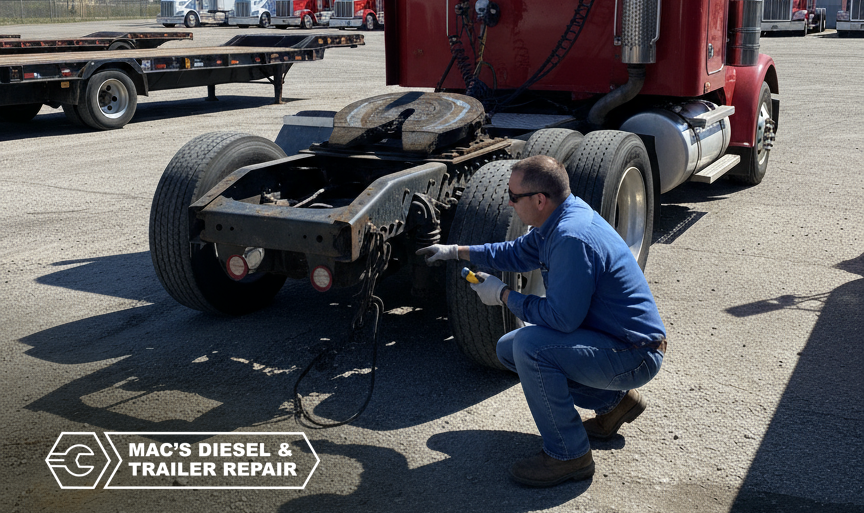
Mastering kingpin inspection accurately will be the key to deciding whether to catch wear early or to face costly repairs later. It is a roundabout inspection procedure that requires a specific technique and positioning in order to obtain precise results.
1. Positioning Your Jack
Start by centering your Jack underneath the front axle. Just make sure it is either under the u-bolt or directly on the axle itself. This location will give steady support through your inspection. Then, lift the truck to the point where one wheel just leaves the ground- you really do not want to go higher than that. Too high, and you will not be able to apply the right amount of pressure so as to feel the play.
2. The One-Side Rule
A key point that a lot of people overlook: raise only one side of the front axle at a time. The opposite wheel should remain on the ground with its full weight. Lifting from the middle or raising both sides simultaneously clears the entire front suspension, making it impossible to detect the subtle movements that indicate king pin wear. You need that opposing weight to create resistance during testing.
3. Testing for Play
Grab a pry bar and position it under the raised tire. Apply upward leverage on the wheel while focusing your attention on the spindle area where the king pin connects. You’re looking for any vertical movement- even slight upward motion indicates wear. Try applying lateral pressure as well to check for side-to-side play in the bushings. The combination of visual observation and feel will tell you what’s happening inside that king pin assembly.
Identifying Symptoms of King Pin Wear
If you know what to look and listen for, it will make your inspection much easier. You can do this by applying pressure with the pry bar and, at the same time, trying to feel that slight movement up of the tire. It might at first look insignificant, but even this small amount of play is a sign that your shims or bushings are getting worn. Listen closely for the sound- more often than not, there will be a clear clicking or creaking sound. This sound is due to the friction generated by the grease present between the shims and the axle as the components move against each other.
The most visible king pin wear symptoms show up on your tires. You’ll notice a specific wear pattern on the inside edge of the tire, where the rubber gets chewed up unevenly. This isn’t random tire damage- it’s a direct result of excessive play in the king pin area. When your king pins have play, your tires can’t maintain proper contact with the road surface, leading to premature tire replacement that hits your wallet hard.
Differentiating king pin issues from other problems requires attention to detail:
- King pin wear creates wobble at specific speeds (typically 45-60 mph) that you can “drive out of”
- Shock absorber failure produces constant vibration throughout your speed range
- Alignment problems cause consistent pulling to one side
- Low air pressure affects overall ride quality
The key distinction? King pin wear produces that characteristic speed-specific wobble and inside tire wear pattern. If you have noticed these signs during your semi truck maintenance checks, it means you have king pin problems that should be fixed before they turn into costly diesel repairs.
Mistakes Often Made During Inspection
While the method above can help you identify some potential kingpin problems, keep in mind, it’s always best to leave it to the pros! There are certain easy mistakes you can make that can influence your king pin check, keeping you from seeing important indicators of wear.
1. Don’t lift from the middle of the truck
One of the most common errors mechanics do during king pin inspections is this one. By lifting the truck’s middle part, you are actually doing it for both sides at the same time, so you cannot feel any change in the moving parts. The right procedure is to lift one side and keep the other grounded; this way, the required tension is formed to demonstrate any change in the kingpin area.
2. Checking for wear is a matter of timing
Your king pin inspection should always be done prior to the greasing of the front end. When you pump grease into the assembly, it fills the spaces between the worn parts and thus temporarily hides the play that you are trying to discover. This lubrication may create an illusion of security with regard to the condition of your king pins.
3. Do not ignore minimal movement
Even the slightest play that seems impossible to notice today may soon develop into a more serious and costly mechanical failure. That subtle click or tiny upward movement of the component you are feeling right now is going to worsen progressively, leading to faster tire wear and perhaps even steering problems that are not safe. Following these maintenance tips can help you avoid costly repairs in the future.
Of course, the eyes of an expert know intimately what to look for, keeping these mistakes out of the equation when taking the best care of your truck that can be done!
The Cost Benefits of Early King Pin Maintenance
Catching king pin wear early saves substantial diesel repair savings that impact your bottom line. When you address minor play before it becomes severe, you protect your tires from premature wear patterns. Are you seeing irregular wear marks? They represent hundreds of dollars in tire life you’re losing with every mile. New tires aren’t cheap, and having to replace them twice as often because of worn king pins means you’re essentially throwing money away.
The financial advantages go far beyond just the tires’ lifespan. Sooner or later, you will be in for major repairs if you keep putting off your whole kingpin assembly, spindles, or even axle work until then, rectifying the situation with little adjustments or shim replacements. The wobble between 45-60 mph that the mechanics talked about? It is your truck that is signaling you to take action now before small repairs turn into major overhauls.
Good king pin maintenance on your semi-truck directly reflects in vehicle handling and safer operation on the road. When your steering components are functioning properly, the emergency maneuvers become less of a challenge, hence the driver is less fatigued and accidents due to mechanical failure are fewer. Your truck performs as designed, which means you’re not compensating for worn components that compromise both efficiency and safety.
Professional Support from Mac’s Diesel and Trailer Repair
When you need expert help with king pin inspections or any heavy-duty truck maintenance, we at Mac’s Diesel and Trailer Repair bring professional truck repair services directly to your location. Our mobile diesel mechanics on-site eliminate the hassle of towing your rig to a shop, saving you valuable time and money.
We specialize in comprehensive king pin checks and adjustments, along with a full range of services including:
- Bus and RV repairs
- DOT inspections
- Emergency roadside assistance
- Preventive maintenance programs
- Custom repair solutions for unique issues
Our diesel mechanics team located in Lexington, Kentucky, is highly trained and is committed to providing exceptional service quality in the surrounding areas. We are aware that every minute of downtime means money lost to you; this means we have made responsiveness our top priority, and we are still doing so with a thorough approach.
Do not wait for the small defect of the kingpin wear to turn into a big issue! Regularly book your preventive maintenance in advance with our reliable specialists, who will be able to detect problems at an early stage. Regardless, if you need a fast inspection or a complete overhauling, our skilled members are equipped with both the modern tools and know-how to keep your truck safe on the road.
Choose Mac’s Diesel and Trailer Repair
Keeping your king pins in check isn’t just about avoiding that annoying wobble between 45 and 60 mph- it’s about protecting your investment and staying safe on the road. Those few minutes spent inspecting for play can save you thousands in premature tire replacements and prevent more serious suspension damage down the line.
How to check king pins on a semi truck and save big on repairs begins by knowing what to look for, but the understanding of when to call in the pros certainly makes a huge difference. Whether it is the familiar clicking sound that you hear or the tire wear patterns that are out of the ordinary, professional diesel mechanics are the ones with the know-how, and they will always catch the issues before they turn into costly problems.
Ready to schedule your semi truck repair appointment? Our team at Mac’s Diesel and Trailer Repair brings the shop to you with comprehensive mobile services. For diesel mechanic contact and expert king pin inspections, call us at (859) 433-4062. We’ll help you keep your rig running safely and efficiently, one inspection at a time.